
About
The Y Method
By Kelsey Mora
Included below:
-
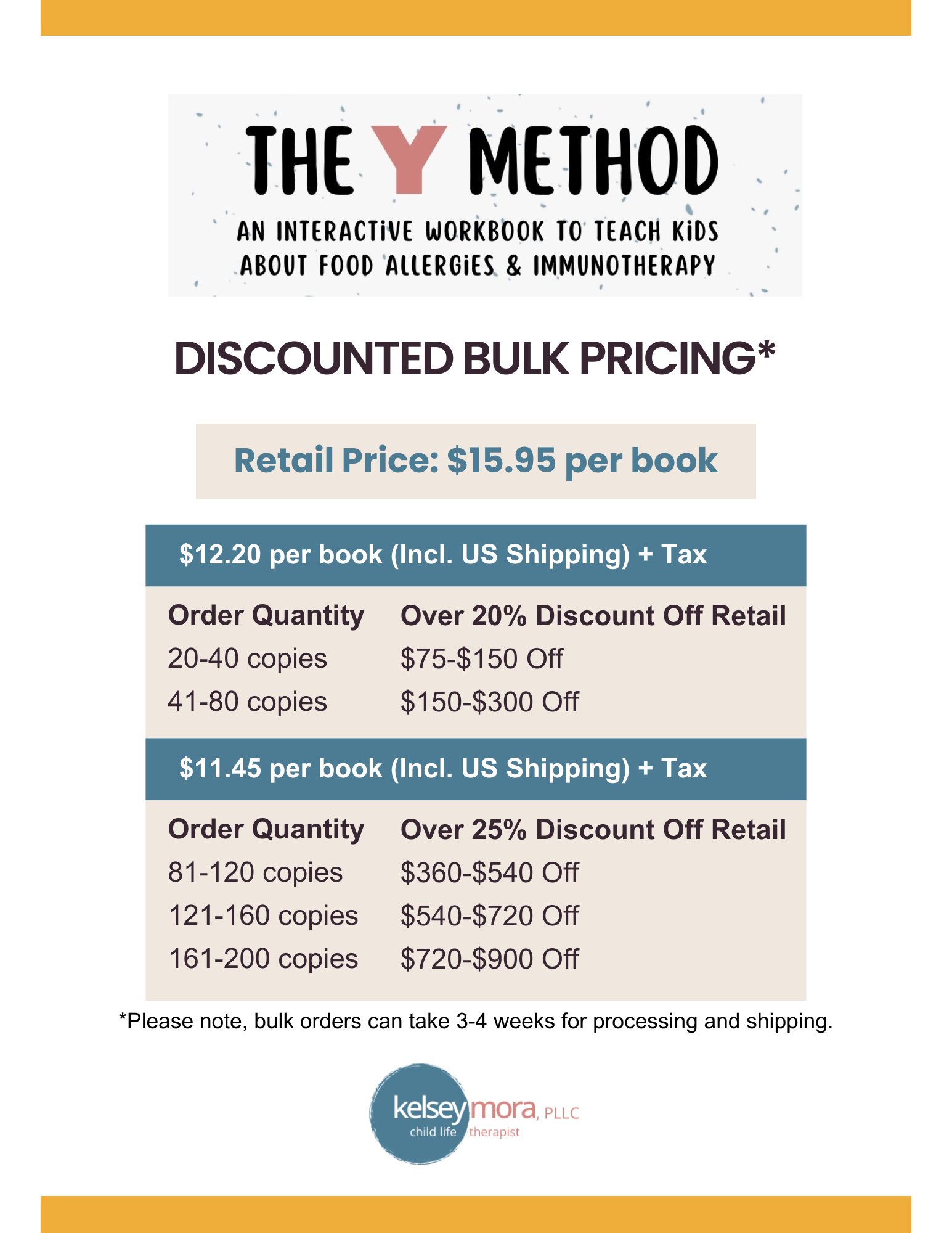
Discounts are available on bulk orders of 20 copies or more. US shipping included. Ideal for hospitals, clinics, and non-profits.
-
The Y Method has been carefully reviewed and endorsed by medical & support professionals, parents, and creators.
-
A list of common questions and answers about how The Dot Method works.
-
A blog with additional guidance on using The Dot Method in different setting and circumstances.
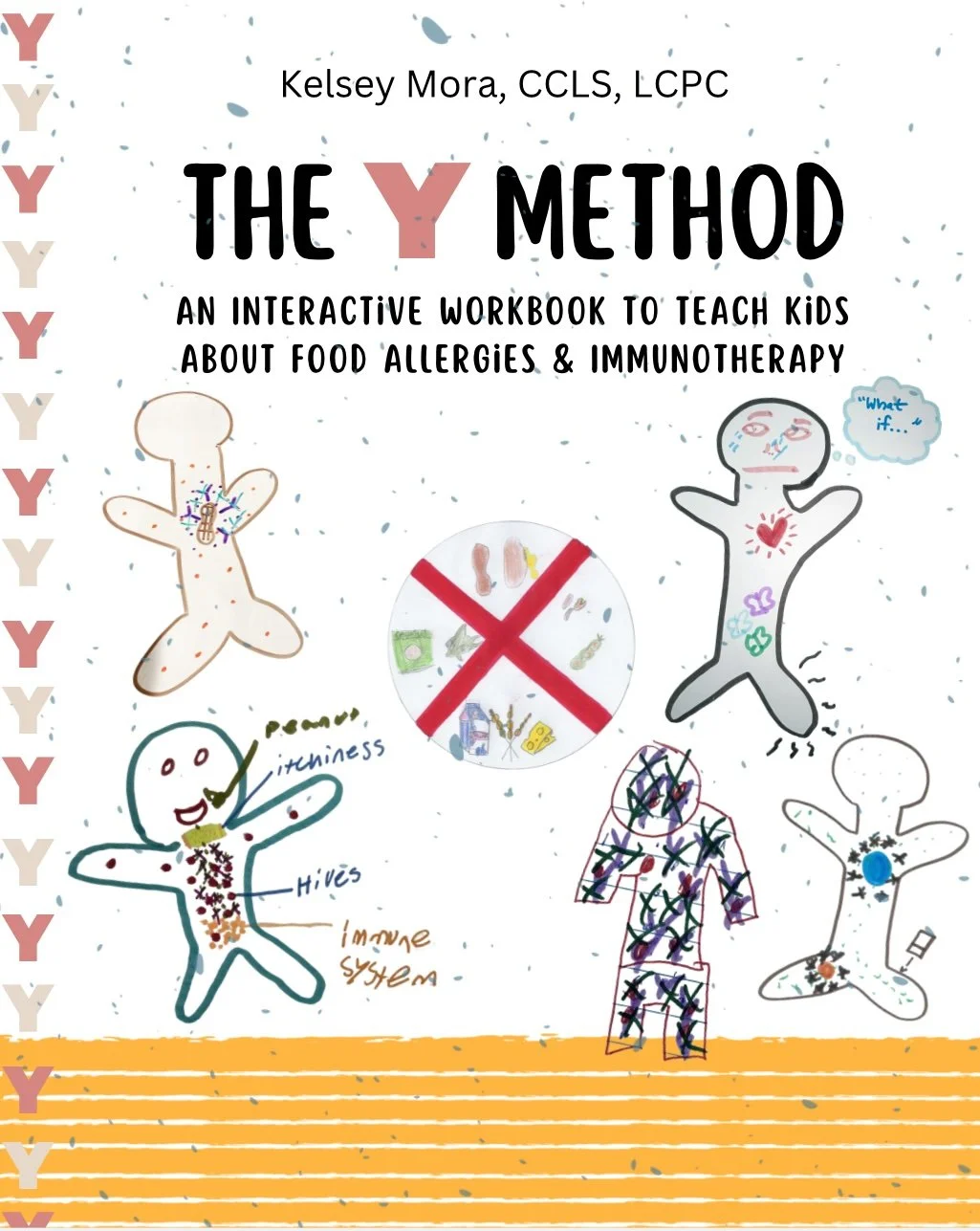
The Y Method is the second of The Method Workbooks.
It’s also the first of it’s kind. A workbook tool that uses hands-on activities to make living with food allergies less confusing and more empowering for kids and caregivers.
Available on Amazon or through Kelsey Mora, PLLC in discounted bulk orders.
Discounted bulk orders available
for clinics and
non-profit organizations*.
*International shipping costs apply
Praise for The Y Method
-
![]()
"The Y Method is an invaluable tool for parents to use to help children age-appropriately understand food allergies, communicate their feelings about food allergies, and ultimately learn how to live life fully, even with food allergies!"
Tamara Hubbard, MA, LCPC, author of May Contain Anxiety: Managing the Overwhelm of Parenting Children with Food Allergies
@foodallergycounselor -
![]()
"Kelsey Mora has developed a tool proven to be an invaluable resource in addressing food anxiety issues, improving the lives of our food allergy patients."
Paul Detjen, MD
-
![]()
"For parents who want help talking to their kids abut food allegies, this workbook provides both structure and heart. It walks kids through the 'what,' the 'why,' and most importantly the 'how do I handle this?" in a way that's both empowering and kid-friendly."
Ina Chung, author of A Kids Book About Food Allergies
@theasianallergymom



Common questions about The Y Method:
Who has food allergies in the workbook?
What is so unique about The Y Method is that it is intended for children impacted by any relationship.
The artist of the book is the child who uses it. On page 4 the child writes the name of the person who has food allergies and uses the body outline to create that person. The child could be creating the workbook about themself, a sibling, or a friend.
What age is The Y Method for?
The Y Method is all about starting conversations early so that you can revisit and build on them over time. As a result, the workbook is listed for children ages 4-12 years however it can be completed with younger and older children. On page ix, there is a guide for how to use and modify the workbook with different ages including 0-4, 5-6, 7-10, and 11 and above.
For young children, the resource may be most helpful to their parents and caregivers in terms of establishing language. However, over time, a family may revisit the workbook and explain more as a child ages and develops.
Should you complete the workbook in one session?
This depends on the child. Some children may complete the workbook from cover to cover and others may complete it over time with a parent, caregiver, or clinician. It’s also common to re-visit the workbook as the child get's older and has more food allergy related experiences and treatment.
Pages 1-14 are focused on learning about food allergies and treatment. Pages 15-28 are focused on feelings and coping with food allergies. This is a natural way to break up the content if needed.
Should The Y Method be completed with an adult?
The Y Method is written so that an older child could complete it independently, however it is intended to prompt meaningful discussions between kids and adults.
If the workbook is being purchased or provided to a parent, it is advised that the parent preview the workbook in its entirety first including the guide and glossary at the front. It is written so that someone with little experience talking to children about food allergies could feel comfortable using it together with a child.
The Y Method is also a great resource for clinicians to use with their patients in the hospital or clinic.
Why is it called The Y Method?
While The Y Method also uses a lot of ‘dots’, it gets its name from the Y antibodies that come into play when learning about why food allergies happen within the immune system. Similarly, when addressing the concept of immunotherapy, less and less of a reaction is produced overtime. Of course the scientific details have been simplified for children to understand but the main concepts are there.
Can you use The Y Method for children with food intolerance, celiac, EoE, or other related conditions?
The Y Method is specifically designed to address IgE-mediated food allergies. As a result, the information about the immune system, anaphylaxis, treatments, etc. may not be as applicable or useful for a non-IgE mediated allergic disease.
However, certainly there are some aspects of the workbook that would apply such as those focused on managing conditions, feelings, coping, creating a plan, and more.